Process & Procurement · 6 min read
How to Read a Contract Lab Certificate of Analysis (Without Missing the Fine Print)
A readable walkthrough of pharmaceutical CoAs from contract testing labs—what each section means, which fields matter for release decisions, red flags, and how pharmacies should file and trend reports.
Updated June 18, 2026
The CoA is a decision document—not a PDF souvenir
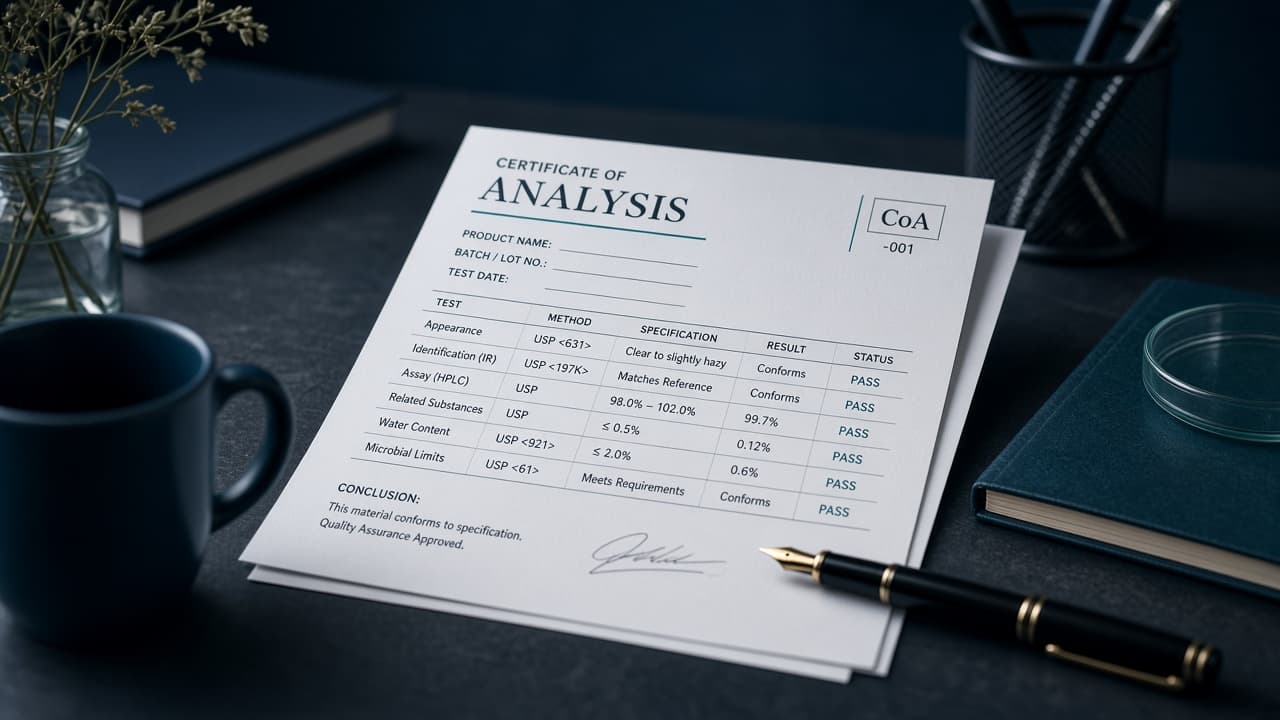
When a contract testing laboratory (CTL) finishes your USP sterility, endotoxin, assay, or microbial limits work, the Certificate of Analysis (CoA) is often the artifact your quality system leans on for release, investigation, or customer assurance. Reading it casually is how teams miss invalid runs, wrong methods, or incomplete scopes.
This guide is a practical tour of what a good pharmaceutical CoA contains, what to verify in the first sixty seconds, and how to file results so they stay useful six months later.
What a strong CoA usually includes
Formats vary, but high-quality reports commonly show:
- Lab identity — legal name, address of the performing site, contact
- Client / sample identity — your organization, sample ID, product name, lot
- Test requested — method reference (e.g., USP <71>, USP <85>, in-house verified assay)
- Receipt / start / report dates — chronology matters for hold-time questions
- Results — values, units, pass/fail vs specification when provided
- Method notes — suitability, dilutions, deviations, invalidations
- Authorization — analyst / reviewer signatures or electronic equivalents
- Accreditation marks — when claimed, they should match the work performed
If any of those blocks are missing on a release-critical test, ask before you file-and-forget.
The sixty-second scan (do this every time)
Before you interpret science, confirm identity:
- Is this your lot and product name?
- Is the test the one you ordered?
- Is the performing site the one you qualified?
- Are dates plausible relative to ship and promised TAT?
- Does the specification on the report match your SOP / customer requirement?
Wrong-lot / wrong-test mix-ups are rare—but expensive. The scan is cheap.
Results section: read units like a scientist
A number without units is incomplete. Confirm:
- Endotoxin in EU/mL or EU/mg as expected
- Assay as % of labeled claim vs mg/mL absolute
- Microbial counts in CFU/g or CFU/mL
- Particulate counts per container volume basis
Then compare to the acceptance criteria you own. Some CoAs print “Pass” against a lab default that is not your release limit. Your QMS wins that argument—if you notice.
Method and suitability footnotes are where truth hides
Especially for first-time matrices, look for:
- Inhibition/enhancement notes (endotoxin)
- Suitability / verification references (assay, <61>/<62>)
- Dilutions used
- “Invalid / retest” language
- Deviations during incubation or instrument runs
A clean results table with a buried “sample diluted 1:10 due to inhibition” is still a valid scientific story—as long as you understand it.
Signatures, data integrity, and revisions
Ask yourself:
- Who reviewed besides who tested?
- Is this revision 1 of 1, or a corrected report?
- If corrected, is the reason stated?
- Can you request raw data / chromatograms / incubator charts when needed?
For 503B and higher-risk release testing, knowing how to obtain supporting data is part of vendor qualification (503B CTL guide).
Red flags worth a phone call
- Performing address missing or different from the site you ship to
- Method listed as “USP-like” with no clarity
- Spec row blank on a pass/fail report
- Obvious typos in product identity left uncorrected
- Accreditation logo with no way to map to scope
- Results reported before sample receipt date (yes, it happens in bad systems)
How to file CoAs so they become knowledge
- Name files with lot + test + date
- Index them to formula version
- Trend quantitative results over time (assay, TAMC, endotoxin)
- Link investigations to the CoA revision used in the decision
- Store submission forms and shipping records with the report
A CoA folder without trending is a graveyard. A CoA library with trends is a control strategy.
Teaching your team a shared language
Create a one-page internal job aid:
- Sixty-second scan checklist
- Who may approve release against a CoA
- When to request raw data
- When to open a lab investigation vs an internal deviation
That alignment matters more than any single vendor portal feature.
Bottom line
Reading a contract lab CoA well is a core pharmacy QA skill. Verify identity and method first, interpret results against your criteria, and treat footnotes as part of the science—not optional fine print.
When you compare labs on LabCompare Rx, ask each finalist for a sample CoA in your method family before you send the first real lot. Clarity on paper predicts clarity under pressure.
Keep reading
 Process & Procurement
6 min read
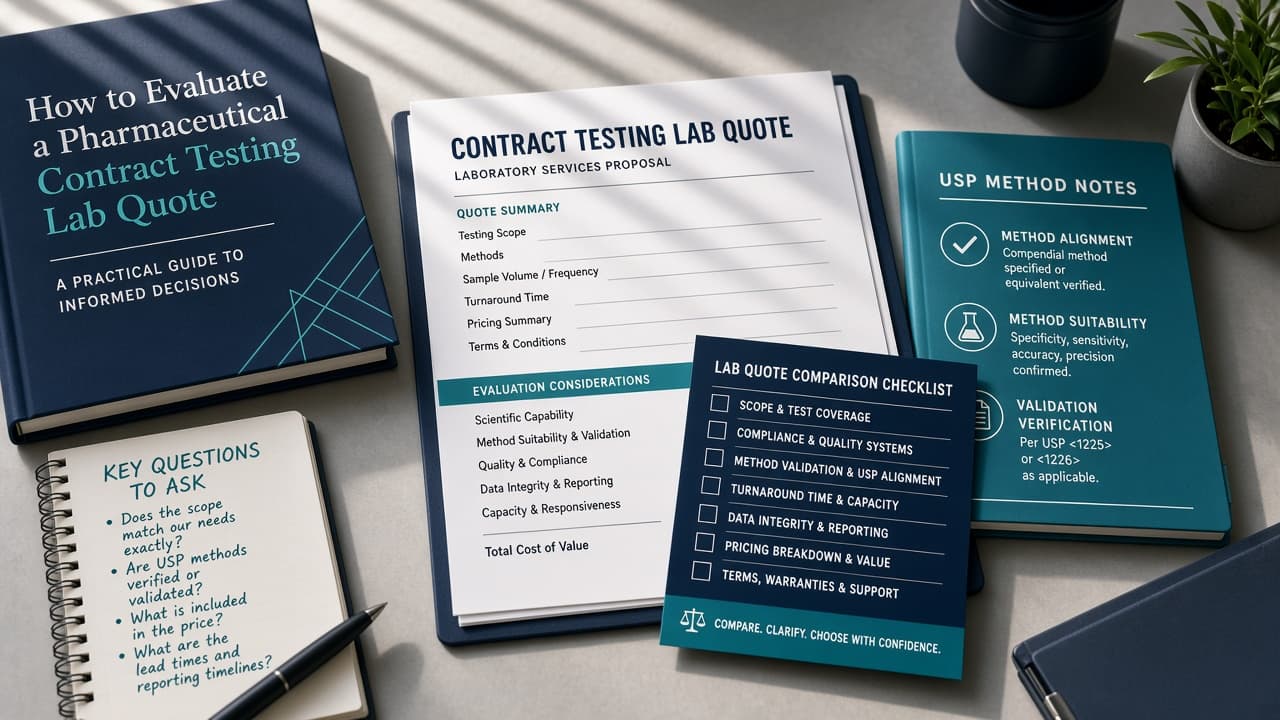
How to Evaluate a Pharmaceutical Contract Testing Quote (Without Getting Burned)
A step-by-step process for pharmacies and QA teams to request, compare, and approve contract testing lab quotes—covering scope gaps, TAT reality, accreditation fit, hidden fees, and quality-agreement must-haves.
Read guide → Process & Procurement
6 min read
How to Ship Samples to a Contract Testing Lab Without Invalidating the Test
A practical shipping and chain-of-custody guide for pharmacies sending samples for USP testing—packaging, temperature control, timing, labeling, and how to align with lab accessioning requirements.
Read guide → Stability & BUD
6 min read
Stability Testing and Beyond-Use Dating: How to Use a Contract Lab Wisely
Educational overview of stability testing support for compounding and outsourcing facilities—study design basics, time-point assays, microbiology overlaps, and how to brief a contract laboratory for BUD-related data.
Read guide →