Process & Procurement · 6 min read
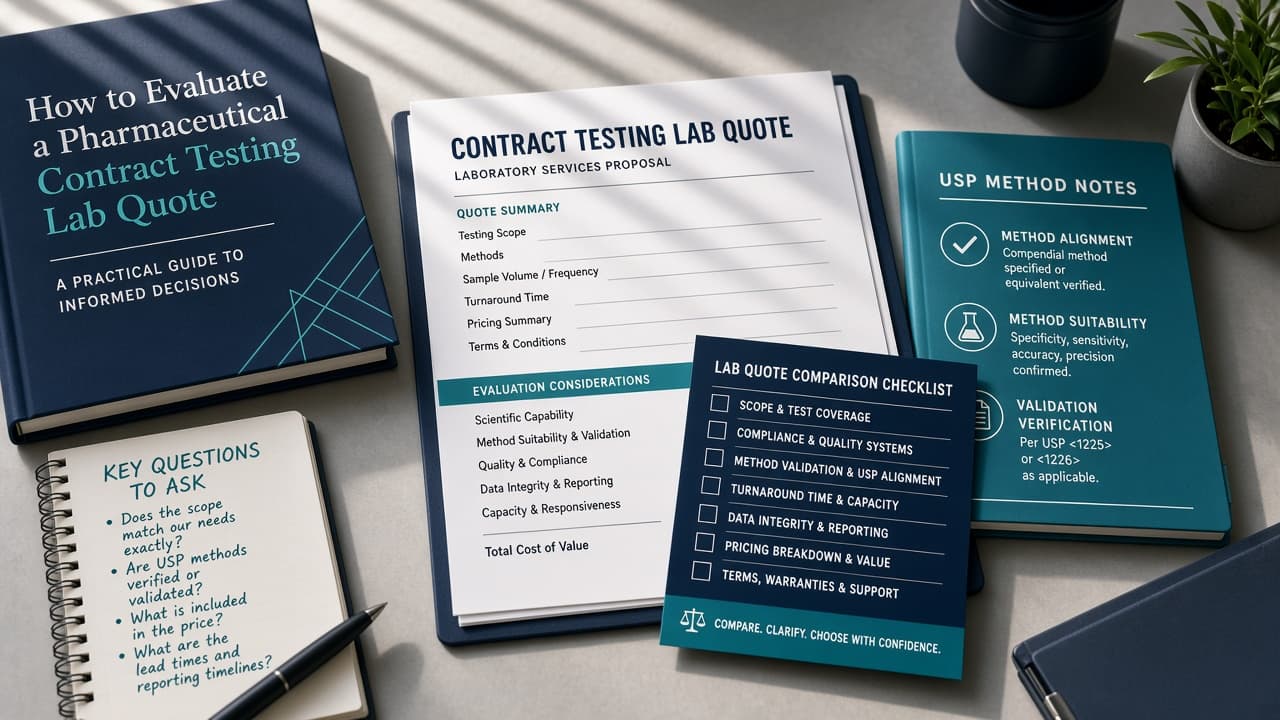
How to Evaluate a Pharmaceutical Contract Testing Quote (Without Getting Burned)
A step-by-step process for pharmacies and QA teams to request, compare, and approve contract testing lab quotes—covering scope gaps, TAT reality, accreditation fit, hidden fees, and quality-agreement must-haves.
Updated September 16, 2026
Most “bad lab experiences” started as a fuzzy quote
Pharmacies rarely regret choosing a slightly more expensive competent lab. They regret choosing a cheap quote that quietly excluded suitability work, rush handling, identification, or investigation support.
This guide gives compounding and specialty pharmacy teams a repeatable process to evaluate pharmaceutical contract testing laboratory (CTL) quotes—especially for USP microbiology and chemistry methods.
Step 1: Write the brief before you invite bids
A strong brief includes:
- Test(s) requested (e.g., USP <71>, <85>, <61>/<62>, potency assay)
- Product matrix and special handling
- Sample quantity available
- Documentation required
- Due date / clinical urgency
- Shipping constraints
- Whether this is one-off, monthly, or annual volume
Send the same brief to every lab. Otherwise you are comparing different jobs.
On LabCompare Rx, attach that brief when you request a quote so labs respond to the same scope.
Step 2: Qualify before you price-shop
Build a must-pass gate:
- Method capability publicly credible
- Accreditation scope fit (ISO/IEC 17025 / A2LA where relevant)
- Acceptable receiving logistics
- Willingness to discuss suitability / method confirmation
- Professional response to your brief (speed alone is not competence)
Disqualify early. Pricing unqualified labs wastes weeks.
Step 3: Demand a scope-complete quote
Your comparison sheet should force clarity on:
- Base analytical fee
- Suitability / onboarding fees for new products
- Rush multipliers and what they change operationally
- Retest policy (lab error vs product failure)
- ID fees (for EM or failure investigations)
- Report package included vs à la carte
- Sample return / disposal fees
- Minimums and cancellation terms
If a quote is a single number with no assumptions, ask for an itemized revision.
Step 4: Separate calendar TAT from marketing TAT
Ask labs to timestamp:
- Receipt → accessioning
- Accessioning → assay start
- Assay start → data review
- Review → CoA release
For incubation-based methods, confirm that “5 days TAT” does not mean “we incubate for fewer days than required.”
Step 5: Score with a weighted matrix (example)
Use weights that match your risk:
| Criterion | Example weight |
|---|---|
| Scope / accreditation fit | 25% |
| Method & matrix experience | 20% |
| Communication / investigation SLA | 15% |
| Logistics & accessioning quality | 15% |
| Documentation quality | 10% |
| Price (complete scope) | 15% |
Adjust weights for your organization—but write them down before opening price emails to reduce bias.
Step 6: Run a pilot when the risk justifies it
For new sterility, endotoxin, or potency partners, a pilot lot (or parallel testing against your incumbent) is cheaper than a recall-scale mistake. Define success criteria in advance: on-time CoA, clear narrative, clean chain of custody, no surprise invoices.
Hidden failure modes to watch
- Bait-and-switch site: sales team in one state, performing lab in another with weaker controls
- Subcontracting without disclosure
- Verbal rush promises not reflected on the quote
- “Includes everything” language that excludes suitability in the footnotes
- Portal-only reports with no audit-friendly PDF archive
Quality agreement basics (even for small pharmacies)
You do not need a 40-page MSA to start, but you do need written alignment on:
- Confidentiality
- Notification of failures / invalids
- Change control for methods
- Record retention
- Contacts and escalation
- How disputes over lab error are handled
Attach the final quote exhibits to the agreement so scope does not drift.
How LabCompare Rx fits this process
LabCompare Rx is built for the shortlist → quote → decision loop:
- Search by USP chapter and credentials
- Open clear lab listings (no invented prices on unclaimed profiles)
- Request quotes from pharmacies
- Claimed labs can respond in-app; admins can help intros for unclaimed listings
That keeps procurement grounded in real capabilities instead of scraped “average price” fiction.
Negotiation without compromising quality
Once two labs clear your technical bar, commercial conversation is appropriate:
- Ask about volume tiers if you will send monthly work
- Bundle related methods (for example <71> + <85>) for operational simplicity
- Confirm whether method onboarding fees are one-time
- Avoid negotiating away investigation notifications or raw-data access
If a lab will only win on price by removing suitability or weekend accessioning you need, that is not a discount—it is a different (worse) service.
Involving the pharmacist-in-charge and QA early
Procurement-only decisions create downstream CAPA pain. Before approving a vendor:
- PIC / quality reviews the method fit
- Operations confirms shipping feasibility
- Finance confirms the complete cost model
- Someone owns ongoing vendor performance review (OTIF CoAs, investigation quality)
Put that RACI in your vendor SOP even if your team is small.
When to re-bid
Re-evaluate when:
- Your product mix changes materially
- TAT performance drifts for 2–3 months
- Accreditation scope changes or lapses
- Communication quality declines
- Volume grows enough to justify a primary/secondary dual-source strategy
Dual-sourcing critical release tests is often worth the administrative cost.
Checklist you can copy into your QMS
- Test brief finalized
- 3 qualified labs identified
- Scopes filed
- Itemized quotes received
- Weighted score completed
- Pilot criteria defined (if needed)
- Quality agreement signed
- Vendor approved in QMS
- Performance metrics assigned to an owner
Bottom line
A pharmaceutical testing quote is a mini protocol plus a commercial offer. Evaluate it like QA, not like office-supply shopping. Scope completeness, accreditation fit, and investigation behavior usually matter more than a small unit-price gap.
When you are ready for the next bid set, build your shortlist on LabCompare Rx and send one clean brief to every candidate.
Keep reading
 Process & Procurement
6 min read
How to Ship Samples to a Contract Testing Lab Without Invalidating the Test
A practical shipping and chain-of-custody guide for pharmacies sending samples for USP testing—packaging, temperature control, timing, labeling, and how to align with lab accessioning requirements.
Read guide →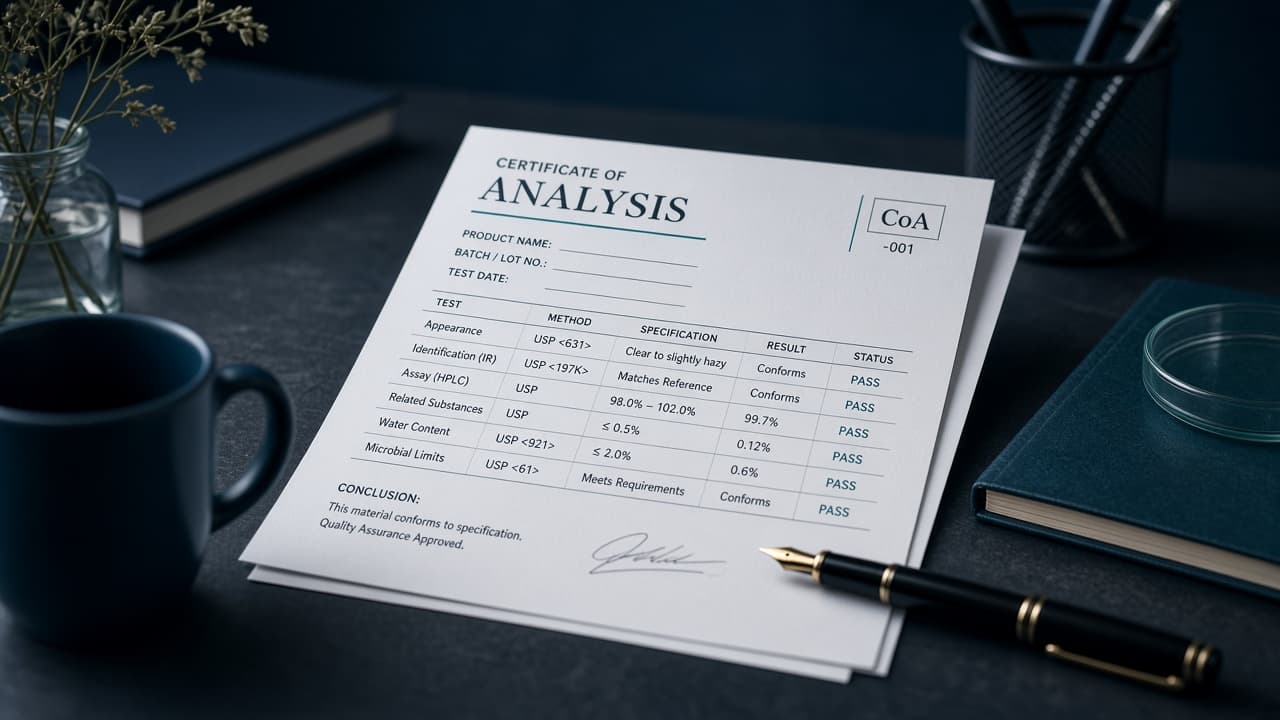 Process & Procurement
6 min read
How to Read a Contract Lab Certificate of Analysis (Without Missing the Fine Print)
A readable walkthrough of pharmaceutical CoAs from contract testing labs—what each section means, which fields matter for release decisions, red flags, and how pharmacies should file and trend reports.
Read guide → Stability & BUD
6 min read
Stability Testing and Beyond-Use Dating: How to Use a Contract Lab Wisely
Educational overview of stability testing support for compounding and outsourcing facilities—study design basics, time-point assays, microbiology overlaps, and how to brief a contract laboratory for BUD-related data.
Read guide →