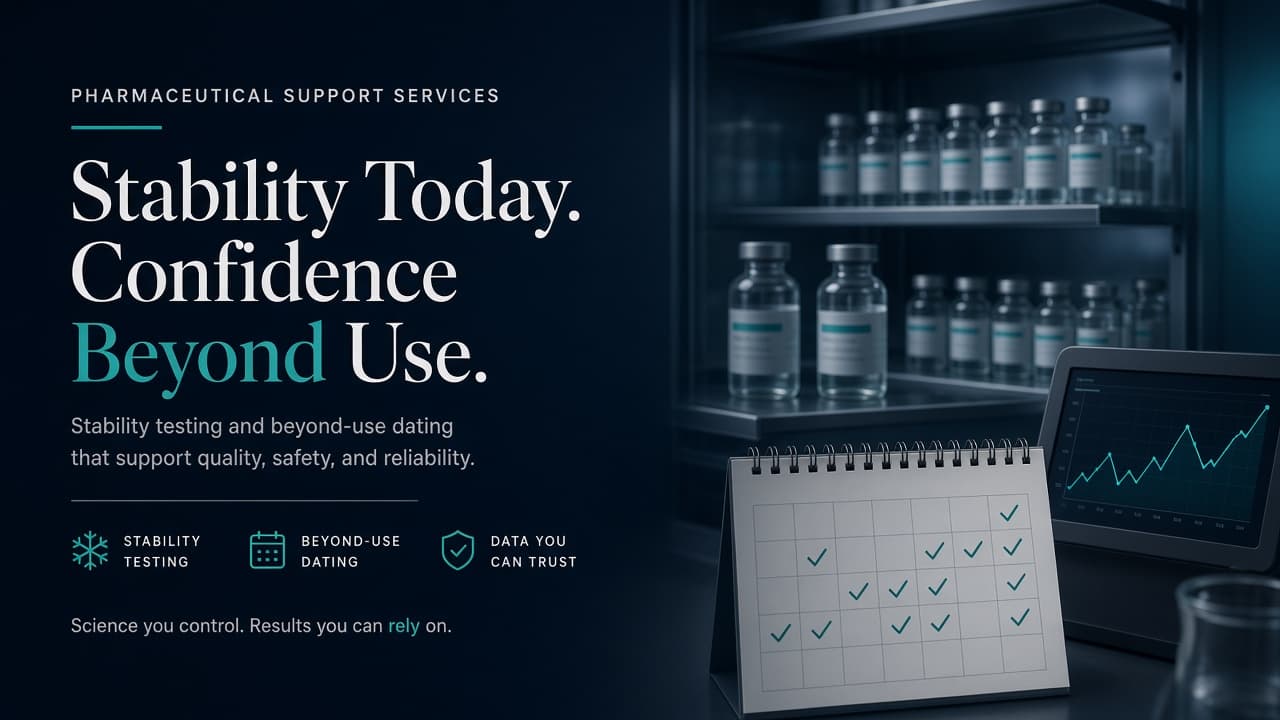
Stability & BUD · 6 min read
Stability Testing and Beyond-Use Dating: How to Use a Contract Lab Wisely
Educational overview of stability testing support for compounding and outsourcing facilities—study design basics, time-point assays, microbiology overlaps, and how to brief a contract laboratory for BUD-related data.
Updated November 24, 2026
Beyond-use dating needs evidence—not optimism
Assigning a beyond-use date (BUD) is one of the most consequential quality decisions in compounding. USP chapters and professional standards set expectations and defaults; extending or defending dating with confidence often requires stability-indicating evidence. Contract testing laboratories can generate that evidence—but only if the study is designed on purpose.
This guide helps pharmacies and 503B teams brief CTLs for stability-related work without confusing a single potency check with a stability program.
Clarify the question you are asking
Different questions need different designs:
| Question | Typical evidence |
|---|---|
| Is today’s lot on strength? | Single-time assay |
| Does this formula hold for X days under stated storage? | Stability protocol with time points |
| Does microbiology remain controlled over dating? | Microbial limits / sterility strategy as applicable |
| What fails first—chemistry or appearance/pH? | Multi-attribute monitoring |
If your brief says only “need BUD testing,” expect mismatched quotes.
Study design basics (pharmacy-owned)
Before calling labs, draft:
- Formula and container-closure exactly as dispensed
- Storage conditions (room temperature, refrigerated, light protection)
- Target dating you hope to support
- Attributes to monitor (assay, appearance, pH, particulates, microbial, etc.)
- Time points (e.g., 0, 7, 14, 30 days—your science may differ)
- Replicates / number of units
- Acceptance criteria drafted in advance
The CTL can advise on analytical feasibility. You own the clinical-quality rationale.
Chemistry attributes commonly outsourced
- Potency / assay over time (potency guide)
- Degradation / related substances when scientifically needed
- pH, appearance, physical stability observations
- Sometimes preservative content for preserved multi-dose formulas
Ask whether the assay is stability-indicating for your purpose—not merely a strength test at t=0.
Microbiology overlaps
Depending on sterile vs nonsterile context:
- Sterile products may involve sterility strategy considerations that are distinct from chemistry dating
- Nonsterile products may include microbial limits at intervals (USP <61>/<62> guide)
- Preservative effectiveness (e.g., USP <51> concepts) may enter the conversation for certain multi-dose formulas
Do not assume a chemistry-only lab can cover the full BUD story.
How to brief a contract lab for stability work
Include:
- Protocol synopsis (even one page)
- Which time points the lab will receive vs pull from retained chamber inventory
- Who holds the stability inventory (pharmacy chamber vs lab chamber)
- Pull schedule and shipping plan for each time point
- Reporting format per time point vs end-of-study summary
- Change rules if an early time point fails
Chamber ownership is a big cost and logistics fork—decide it explicitly.
Interpreting early failures
If t=7 fails assay:
- Stop hope-based continuation without a plan
- Investigate method validity and sample handling first
- Revisit formula, container, or target dating
- Document scientifically—do not silently shorten labels without QMS control
A good CTL helps with analytical root-cause; formulation decisions remain yours.
Quote structures to demand
Stability quotes should break out:
- Method setup / verification
- Per-time-point analytical fees by attribute
- Chamber storage fees (if lab-hosted)
- Microbiology fees (if included)
- Cancellation terms if the study stops early
- Rush replacements if a pull is missed
Compare total study cost, not only “assay price.”
Common failure modes when outsourcing BUD support
- Using a single potency result to “justify” long dating
- Changing container-closure mid-study without documenting impact
- Missing pull windows because shipping was an afterthought
- No pre-set acceptance criteria (moving the goalposts)
- Choosing a lab that cannot run both chemistry and needed micro attributes
Practical pathway for smaller compounding pharmacies
- Start with a high-impact formula family
- Keep first study lean but scientifically honest
- Use defaults where evidence is weak; extend only where data support
- Qualify one chemistry CTL and one micro CTL (or a dual-capable partner)
- File protocols and raw summaries in the QMS for inspectors and clinicians
Where LabCompare Rx helps
- Find labs by USP/analytical capability
- Request quotes with identical protocol synopses
- Keep vendor options visible when you need a backup analytical site
Start at the guides hub or directory search.
Bottom line
Stability support for beyond-use dating is a designed study, not a single lab order code. Own the protocol, choose CTLs that can execute the attributes you named, and let evidence—not optimism—set the date on the label.
When you are ready, shortlist analytical and microbiology partners on LabCompare Rx and send one shared study synopsis to every bidder.
Keep reading
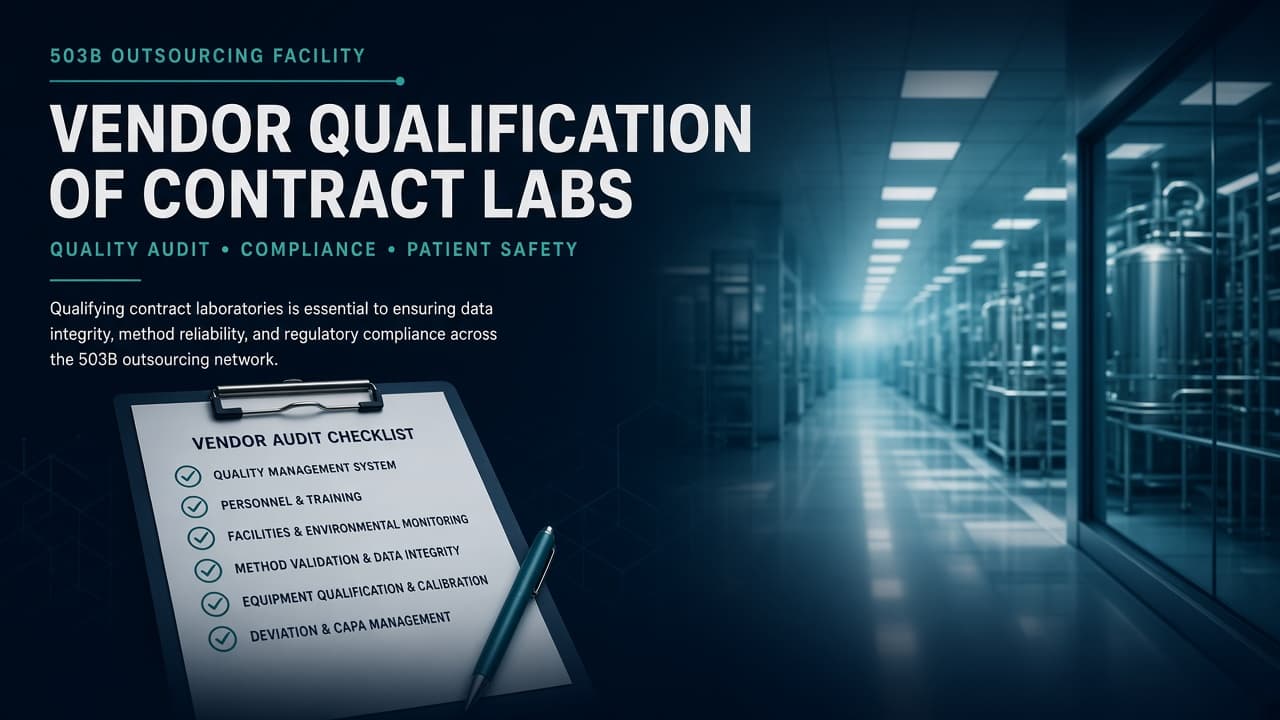 503B & Quality Systems
6 min read
503B Outsourcing Facilities: How to Qualify Contract Testing Laboratories
A process guide for 503B quality teams qualifying pharmaceutical CTLs—risk ranking tests, audit questions, quality agreements, data integrity expectations, and ongoing vendor performance management.
Read guide →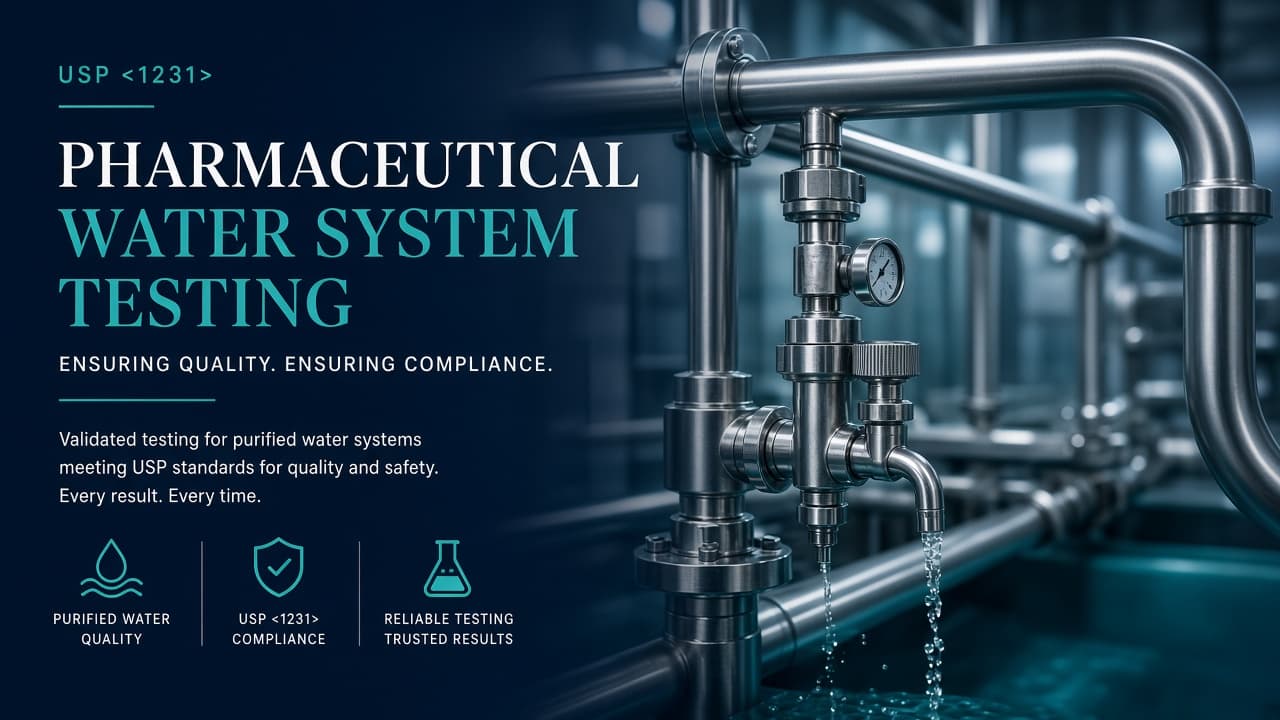 Facilities & Utilities
6 min read
Pharmaceutical Water Testing for Compounding Facilities: A Practical Outsourcing Guide
How compounding and 503B teams should approach pharmaceutical water testing—conductivity, TOC, endotoxin, bioburden, sampling discipline, and choosing a contract lab for USP water attributes.
Read guide → Analytical Chemistry
6 min read
Potency and Assay Testing for Compounding Pharmacies: How to Outsource with Confidence
Educational guide to potency/assay testing for compounded preparations—method selection, reference standards, acceptance criteria, stability overlaps, and how to evaluate analytical contract laboratories.
Read guide →