503B & Quality Systems · 6 min read
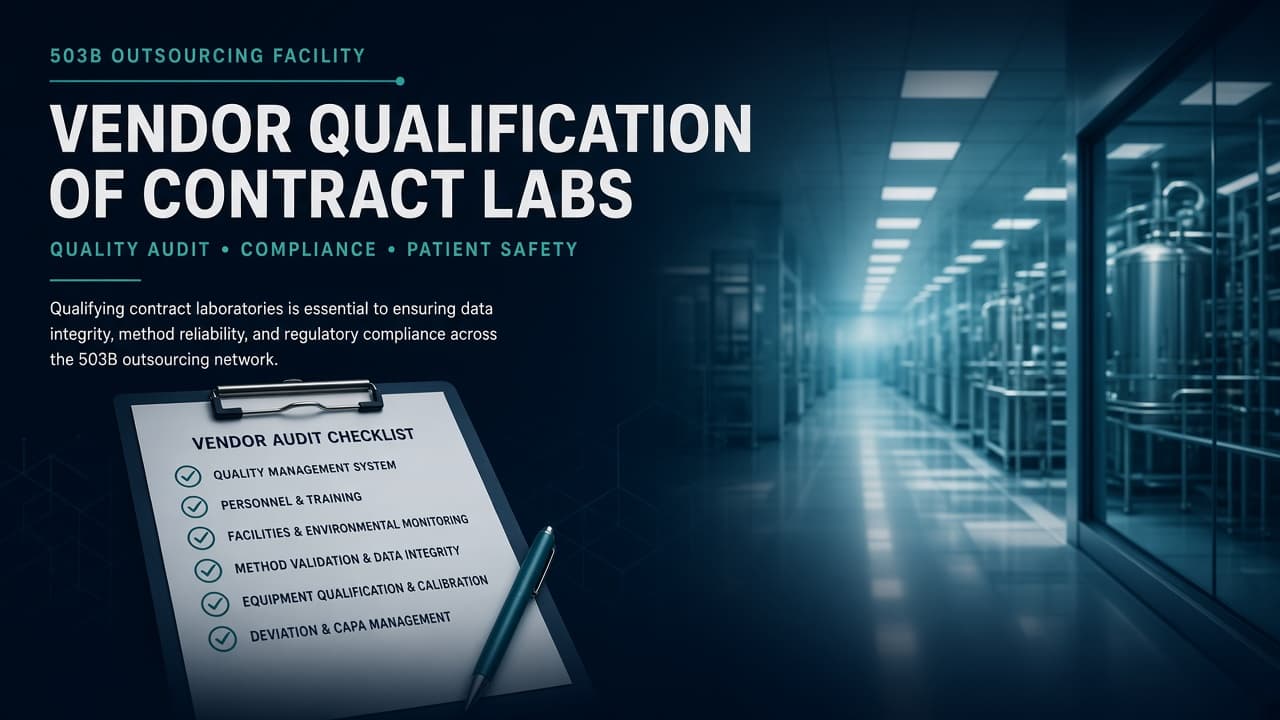
503B Outsourcing Facilities: How to Qualify Contract Testing Laboratories
A process guide for 503B quality teams qualifying pharmaceutical CTLs—risk ranking tests, audit questions, quality agreements, data integrity expectations, and ongoing vendor performance management.
Updated November 12, 2026
503B release decisions amplify laboratory risk
For outsourcing facilities, contract testing laboratories sit on the critical path of lot release, stability, environmental monitoring support, and investigations. A weak CTL is not a “supplier issue”—it is a product quality and regulatory exposure issue.
This guide outlines a practical qualification path that 503B quality teams can adapt: risk ranking, document review, audit focus areas, quality agreements, and ongoing monitoring.
Start with a test risk map—not a vendor popularity contest
List every externally tested attribute, for example:
- Sterility (USP <71>)
- Endotoxin (USP <85>)
- Assay / impurities
- Particulates
- Container closure / integrity related tests as applicable
- EM incubation / ID support
- Water attributes
- Stability time points
Risk-rank by patient impact and detection difficulty. High-risk tests deserve deeper qualification (on-site or rigorous remote audit, stricter agreements, dual-source strategy).
Phase 1 — Paper qualification
Collect:
- ISO/IEC 17025 certificate + current scope (how to read scopes)
- Organizational chart / key technical contacts
- Quality manual index or equivalent overview
- Sample CoAs for your method families
- Deviation / OOS procedure summaries
- Data integrity / computer system overview (as applicable)
- Subcontracting policy
- Facility addresses for performing sites
Disqualify on scope mismatch before anyone books flights.
Phase 2 — Technical discussion
Run a structured call:
- Walk a mock sample from receiving → CoA
- Ask how invalid assays are declared
- Ask who can stop a lot recommendation conversation ethically when data are weak
- Review turnaround assumptions for your volume
- Confirm weekend/holiday coverage for incubation methods
- Discuss change control notifications (method, equipment, site)
Score the conversation. Charm is not competence.
Phase 3 — Audit (remote or on-site)
High-value audit threads:
- Training and analyst qualification records for your methods
- Reference standard control
- Chamber/incubator monitoring and alarms
- Method verification / validation packages
- Investigation depth on recent OOS examples (redacted)
- Electronic records controls where used
- Sample labeling / chain of custody
- Cleanliness and segregation for microbiology vs chemistry as relevant
For sterility-heavy relationships, microbiology contamination control culture matters as much as SOP binders.
Quality agreements that actually operate
At minimum, define:
- Specimens covered and turnaround commitments
- Notification timelines for failures, invalids, and deviations
- Change control thresholds requiring customer approval or notice
- Data ownership, retention, and audit rights
- Confidentiality
- Subcontracting disclosure rules
- Escalation contacts 24/7 for sterile release blockers
Attach method lists and quote exhibits so commercial scope cannot silently shrink.
Dual sourcing and business continuity
For release-critical tests, consider:
- Primary + qualified backup lab
- Periodic proficiency-style cross-checks
- Pre-approved shipping lanes to the backup site
The worst time to qualify a backup sterility lab is during an incubator failure at your primary.
Ongoing performance metrics
Track monthly or quarterly:
- On-time CoA rate
- Invalid / repeat rates
- Investigation cycle time
- Documentation error rate
- Responsiveness scores from QA
Demote vendors with drifting metrics even if unit price is attractive.
How 503A customers and 503B providers should align
If you are a 503B selling to health systems or compounding pharmacies, your CTL qualification package often becomes part of customer assurance. Keep a clean, shareable summary (non-confidential) of lab qualifications for business development—without oversharing raw audit findings.
Using LabCompare Rx in 503B sourcing
Use the directory to:
- Build longlists by USP chapter and accreditation signals
- Request structured quotes with identical briefs (quote evaluation guide)
- Identify claimable profiles for direct lab relationships
- Keep sourcing transparent when leadership asks “who else is out there?”
Bottom line
503B CTL qualification is risk management. Paper, technical dialogue, audit, agreement, and metrics each catch failures the others miss. Do not skip steps for speed when the test stands between a lot and a patient.
Shortlist candidates on LabCompare Rx, then run them through your full qualification playbook before the first GMP shipment.
Keep reading
 Stability & BUD
6 min read
Stability Testing and Beyond-Use Dating: How to Use a Contract Lab Wisely
Educational overview of stability testing support for compounding and outsourcing facilities—study design basics, time-point assays, microbiology overlaps, and how to brief a contract laboratory for BUD-related data.
Read guide → Facilities & Utilities
6 min read
Pharmaceutical Water Testing for Compounding Facilities: A Practical Outsourcing Guide
How compounding and 503B teams should approach pharmaceutical water testing—conductivity, TOC, endotoxin, bioburden, sampling discipline, and choosing a contract lab for USP water attributes.
Read guide → Analytical Chemistry
6 min read
Potency and Assay Testing for Compounding Pharmacies: How to Outsource with Confidence
Educational guide to potency/assay testing for compounded preparations—method selection, reference standards, acceptance criteria, stability overlaps, and how to evaluate analytical contract laboratories.
Read guide →