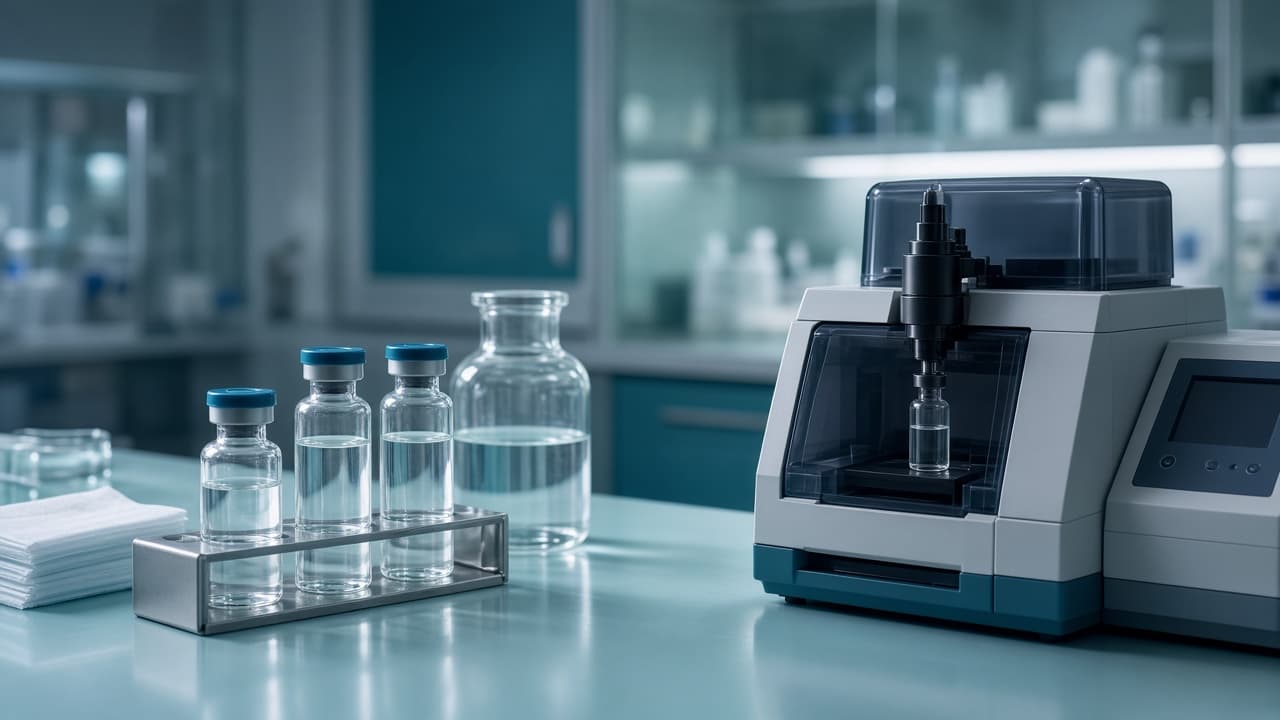
USP Microbiology · 6 min read
USP <788> Particulate Matter in Injections: A Practical Guide for Sterile Teams
An accessible guide to USP <788> particulate matter testing for injectable preparations—why particles matter, light obscuration vs microscopy, how to brief a contract lab, and how to act on results.
Updated September 3, 2026
Invisible particles still reach patients
Sterile injectable preparations can pass a visual check and still contain subvisible particulate matter—fragments from process, packaging, or environment that matter clinically and regulatorily. USP <788> Particulate Matter in Injections is the chapter most teams mean when they say “particle count” for injectables.
Whether you compound sterile preparations, support 503B release, or investigate customer complaints, particulate testing is one of the quiet essentials of injectable quality. This guide explains the concept in plain language and how to work with a contract testing lab (CTL).
Why particulate control belongs in your quality story
Particulates can originate from:
- Glass vials and elastomeric closures
- Tubing, filters, and single-use components
- Environmental dust and fibers
- Undissolved drug or aggregation
- Improper mixing or filtration practice
Patients on intravenous therapy have limited tolerance for avoidable particle burden. That is why pharmacopeial controls exist—and why “it looked clear” is not a complete release philosophy for many injectable contexts.
What USP <788> is (high level)
USP <788> provides approaches for counting and sizing particles in injections, commonly discussed in terms of:
- Light obscuration particle count methods
- Microscopic methods when light obscuration is unsuitable
Product type, viscosity, and optical properties influence which approach is appropriate. Your quality brief should not assume every cream-colored suspension or viscous product belongs on the same instrument path as a clear aqueous vial.
Always align SOPs to the currently applicable chapter text and your product-specific strategy.
When sterile teams outsource <788>
- In-house particle counters are unavailable or unverified
- Method suitability questions need experienced analytical support
- Investigation of visible particulates or filterability issues
- 503B / customer expectations for documented particulate testing
- Stability programs that include particulate attributes over time
Outsourcing works best when you already know why you are testing—not only that a menu item exists.
Briefing a CTL for particulate work
Include:
- Exact product description and container configuration
- Aqueous vs oily / suspension characteristics
- Target chapter approach if known (or ask for recommendation)
- Volume available per determination
- Acceptance criteria you will apply
- Whether this is lot release, development, or investigation
- Shipping and light/temperature constraints
See also sample shipping discipline—foam flecks from poor packaging are not a clever way to fail <788>.
Method fit questions that separate specialists from generalists
Ask the lab:
- When do you recommend microscopy over light obscuration for products like ours?
- How do you handle highly viscous or opaque matrices?
- What system suitability / calibration checks support the run?
- How are results reported (size bins, per-container basis)?
- Can you support investigations with photomicrographs when relevant?
A lab that only quotes “788 – $X” without matrix conversation may be fine for simple clear solutions—and a poor fit for everything else.
Interpreting results calmly
Pass
File against lot and process conditions. Watch for upward trends even while still passing.
Fail / elevated counts
Investigate process and packaging before assuming lab error:
- Filter integrity and flush practices
- Component lots (stoppers, vials)
- Mixing / compounding technique
- Environmental contribution
- Sample handling artifacts
Pair analytical discussion with manufacturing reality. Request a clear narrative on the CoA.
Relationship to sterility and visual inspection
Particulate testing complements—not replaces:
- Visual inspection programs
- Sterility testing (USP <71>)
- Process controls and filtration strategy
A sterile product can still have an unacceptable particle profile. Keep the concepts distinct in training.
How to compare particulate testing quotes
Force clarity on:
- Method approach for your matrix
- Sample volume requirements
- Per-sample vs per-lot pricing assumptions
- Investigation add-ons (microscopy images)
- TAT including instrument queue reality
Browse injectable-capable CTLs on LabCompare Rx and send an identical product brief to each.
Bottom line
USP <788> protects patients from a risk you often cannot see with the naked eye. Brief the matrix honestly, choose labs that understand injectable optics—not just “particle counting”—and trend results so small process drifts become visible early.
When you are ready, shortlist partners through LabCompare Rx and treat particulate testing as part of your sterile control strategy, not an afterthought line item.
Keep reading
 USP Microbiology
6 min read
USP <61> and <62> Microbial Limits: What Nonsterile Compounding Teams Should Know
A practical educational guide to USP <61> TAMC/TYMC and USP <62> specified microorganisms for nonsterile compounding—when to test, how to brief a contract lab, and how to interpret results without overreacting.
Read guide → USP Microbiology
6 min read
USP <71> Sterility Testing: How Compounding Pharmacies Should Choose a Contract Lab
A practical guide to USP <71> sterility testing for 503A/503B pharmacies—what the method covers, what to ask a contract testing lab, sample handling, TAT tradeoffs, and accreditation signals that matter.
Read guide → USP Microbiology
6 min read
USP <85> Bacterial Endotoxin (LAL) Testing: A Practical Guide for Compounding Teams
Understand USP <85> bacterial endotoxin testing for sterile compounding and outsourcing facilities—LAL method choices, interference, sampling strategy, and how to evaluate contract labs for endotoxin work.
Read guide →