USP Microbiology · 6 min read
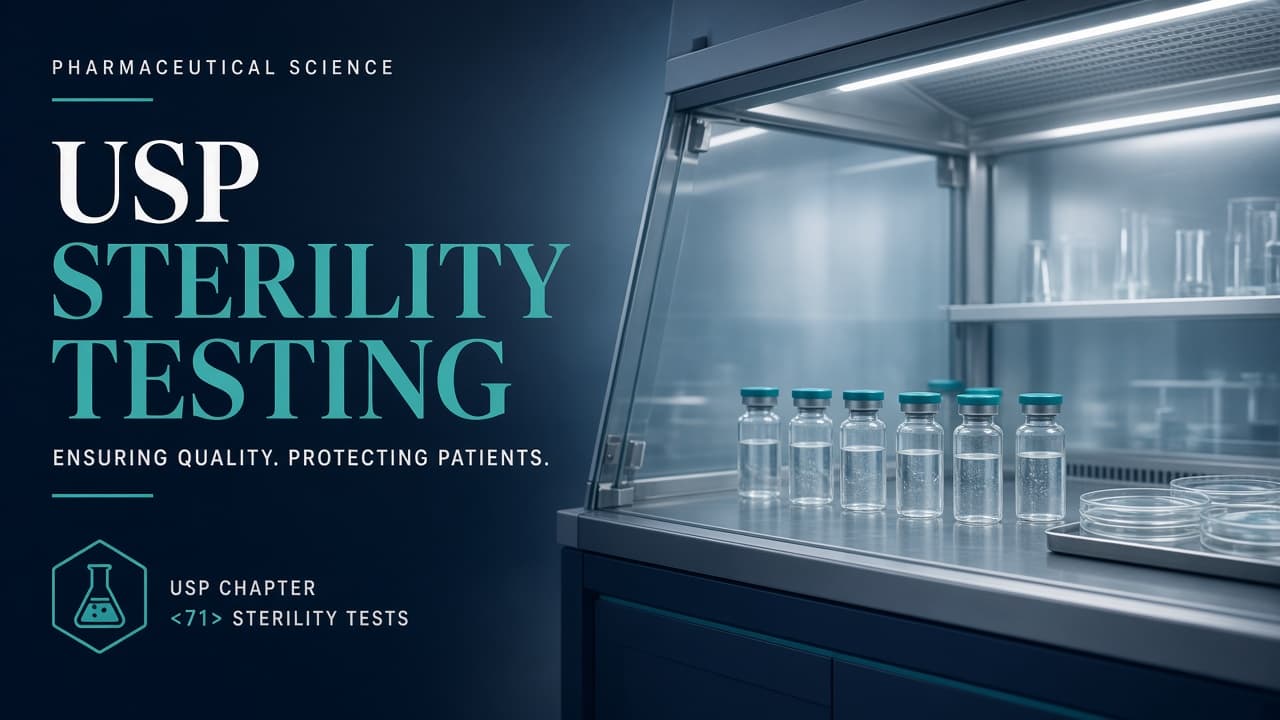
USP <71> Sterility Testing: How Compounding Pharmacies Should Choose a Contract Lab
A practical guide to USP <71> sterility testing for 503A/503B pharmacies—what the method covers, what to ask a contract testing lab, sample handling, TAT tradeoffs, and accreditation signals that matter.
Updated September 16, 2026
Why sterility testing sits at the center of sterile compounding QA
If you prepare sterile compounded preparations—or release sterile finished product from a 503B outsourcing facility—USP <71> Sterility Tests is one of the highest-stakes external laboratory decisions you make. A false pass can put patients at risk. A false fail or poorly executed method can destroy inventory, delay therapy, and create investigation burden you did not budget for.
Pharmacies increasingly outsource <71> to contract testing laboratories (CTLs) because the method is resource-heavy: controlled media, incubation capacity, trained analysts, and documented environmental controls. The question is not only “who can run sterility?” but who can run it in a way your quality system can defend.
This guide walks through what USP <71> is asking for, how to evaluate labs, and how to request quotes without getting lost in marketing language.
What USP <71> is (and is not)
USP <71> provides procedures for determining whether a substance or preparation complies with requirements for sterility. In practice for compounding and outsourcing facilities, that usually means:
- Membrane filtration when the product can be filtered without compromising the test
- Direct inoculation when filtration is not suitable
- Defined media (commonly Fluid Thioglycollate Medium and Soybean–Casein Digest Medium)
- Defined incubation conditions and durations
- Growth promotion / suitability considerations so the product matrix does not invalidate the method
USP <71> is not a substitute for a validated aseptic process, environmental monitoring program, or release strategy that includes other critical attributes (for example endotoxin under USP <85> when applicable). It is one control among several.
Also important: sterility testing is a destructive sample-based evaluation. It cannot prove every unit is sterile. Your SOPs should reflect that statistical and process reality—especially when talking with auditors.
When pharmacies typically send <71> to a contract lab
Common outsourcing triggers:
- Volume spikes — batch release exceeds in-house incubator or staffing capacity
- Method complexity — oily vehicles, suspensions, devices, or matrices that need filtration method development
- Investigation support — media fill failures, EM excursions, or complaint samples needing an independent lab
- 503B scale — commercial batch sizes where dedicated CTL capacity is more reliable than ad-hoc in-house capacity
- Accreditation strategy — leadership prefers ISO/IEC 17025 accredited external testing for certain release tests
If you are shopping labs for the first time, start by writing a one-page “test brief” before you email anyone. It will dramatically improve quote quality.
Build a one-page sterility test brief before you request quotes
Include:
- Product type (aqueous injectable, ophthalmic, lyophilized, oil, device-related, etc.)
- Approximate fill volume / unit size and number of units you can allocate to testing
- Whether the product is bacteriostatic / contains preservatives
- Preferred approach if known (filtration vs direct inoculation) — or ask the lab to recommend
- Required documentation pack (CoA format, raw data on request, deviation notification SLA)
- Needed turnaround: standard vs expedited, and whether weekends matter
- Shipping constraints (cold chain, light sensitivity, controlled substance handling if applicable)
- Your state / DEA / FDA registration context if it affects receiving
Vague RFQs create vague quotes. Specific briefs create comparable bids.
Accreditation and quality signals that actually matter
For sterility outsourcing, prioritize evidence over adjectives:
ISO/IEC 17025 accreditation
Look for a current scope that clearly includes sterility or biological / microbiological pharmaceutical testing—not a generic “environmental microbiology” certificate that may not match your product type. Ask for the scope PDF.
A2LA or another ILAC MRA signatory
A2LA (and peer accreditors) make scopes easier to verify. Accreditation is not a guarantee of perfect performance, but it is a strong signal that the lab’s quality system is independently assessed.
FDA registration / inspection posture
Many CTLs are FDA-registered. Registration alone is not a quality score. Still, for 503B and higher-risk sterile work, pharmacies often prefer labs accustomed to FDA-facing documentation expectations.
Method suitability experience
Ask: “Have you performed <71> suitability on products like ours?” Request examples of matrix challenges they have solved (without expecting them to share confidential client names).
Investigation maturity
What happens if growth is observed? How fast are you notified? Who writes the deviation narrative? Can they support OOS / OOT style communication your QMS expects?
Sample plan, shipping, and chain of custody
Sterility failures are sometimes shipping failures in disguise.
Best practices:
- Agree sample quantity and configuration in writing before you ship
- Use shippers validated for your temperature profile
- Avoid Friday arrivals unless the lab confirms same-day accessioning
- Label with product ID, lot, manufacture date, and “USP <71> — do not open outside clean area” style handling notes as directed by the lab
- Confirm whether the lab wants retain units beyond the test set
Ask the lab for a written accessioning checklist. Strong labs already have one.
Turnaround time: how to read the promise
Sterility incubation itself consumes calendar time. Marketing that implies “same-week sterility for everything” without caveats should make you ask follow-up questions.
When comparing TATs:
- Separate accessioning + method setup from incubation clock
- Ask whether suitability work is included or billed/timed separately for new products
- Confirm holiday and weekend incubator monitoring
- Ask what “preliminary” updates mean (if any) versus final CoA
Expedited fees are sometimes worth it for clinical need—but only if the lab is accelerating administrative and capacity steps, not silently shortening scientifically required incubation.
How to compare quotes without getting trapped by sticker price
Price matters. For sterility, incomplete scope matters more.
A usable quote should clarify:
- Per-test / per-batch pricing and what constitutes a “batch”
- Suitability / validation charges for new products
- Media fill or investigation add-ons (if relevant)
- Rush multipliers
- Report format and archival retention
- Retest policy if lab assignable error occurs
Then score labs on a simple matrix: accreditation fit, matrix experience, communication SLA, shipping logistics, documentation quality, and price. The lowest number is not always the lowest risk.
Red flags
- Cannot produce a current ISO 17025 scope covering sterility-related work
- Vague about growth investigation timelines
- Discourages suitability discussions for novel vehicles
- No clear receiving address / accessioning instructions
- Pressure to skip written method confirmation “to save time”
A practical selection workflow
- Shortlist 3 labs with pharmaceutical microbiology credentials (browse LabCompare Rx by USP chapter)
- Send the same test brief to all three
- Review scopes + sample CoA formats
- Do a 20-minute technical call with the top two
- Run a pilot lot before committing annual volume
- Document the approved vendor in your quality system
Bottom line
Choosing a USP <71> partner is a quality-system decision disguised as a purchasing decision. The best labs make method suitability, shipping, investigation communication, and documentation feel boring—in the best way. Boring, repeatable sterility testing is exactly what patients and auditors need.
When you are ready to compare accredited options, use LabCompare Rx to filter labs by USP capabilities and request quotes with a clear brief attached.
Keep reading
 USP Microbiology
6 min read
USP <61> and <62> Microbial Limits: What Nonsterile Compounding Teams Should Know
A practical educational guide to USP <61> TAMC/TYMC and USP <62> specified microorganisms for nonsterile compounding—when to test, how to brief a contract lab, and how to interpret results without overreacting.
Read guide → USP Microbiology
6 min read
USP <85> Bacterial Endotoxin (LAL) Testing: A Practical Guide for Compounding Teams
Understand USP <85> bacterial endotoxin testing for sterile compounding and outsourcing facilities—LAL method choices, interference, sampling strategy, and how to evaluate contract labs for endotoxin work.
Read guide → USP Microbiology
6 min read
USP <788> Particulate Matter in Injections: A Practical Guide for Sterile Teams
An accessible guide to USP <788> particulate matter testing for injectable preparations—why particles matter, light obscuration vs microscopy, how to brief a contract lab, and how to act on results.
Read guide →